Game Genie
An adaptive, AI-powered game that makes learning fun by turning core subjects into engaging, gamified challenges
Role
Product Designer & Researcher
Industry
Education Technology
Duration
72 hours
Overview
This project was created during my Product Design Internship at Tech Tykes, an after-school program dedicated to teaching kids coding and digital art through playful, accessible experiences. While Tech Tykes focuses on empowering students as creators in the digital space, the team also saw an opportunity to support learning in core classroom subjects. That's where Game Genie came in.
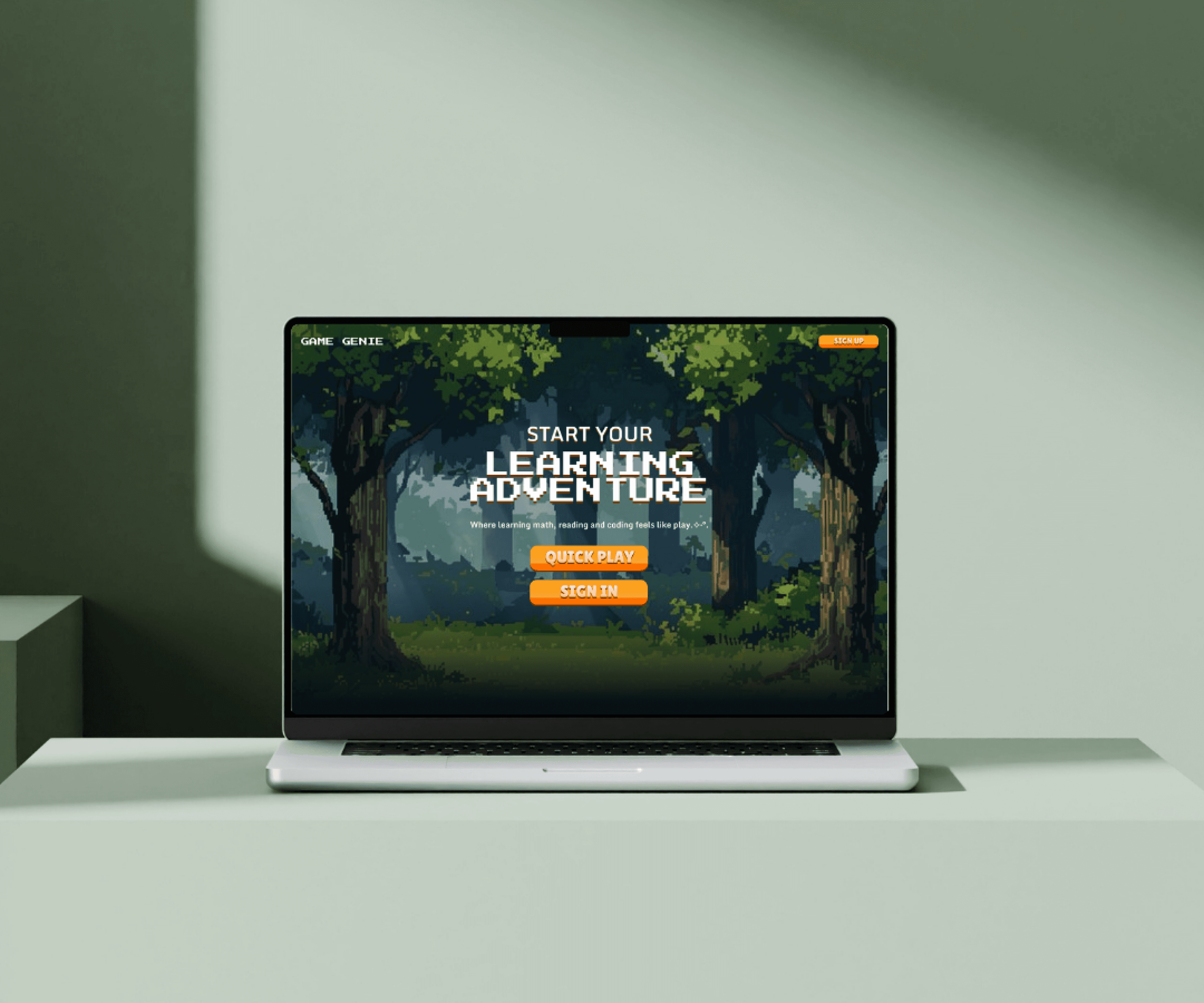
Game Genie is an AI-powered word game, inspired by Wordle, designed to make learning fun, adaptive, and meaningful for young learners. With features like adaptive difficulty, AI-powered hints, and contextual practice, the game turns short breaks in and out of the classroom into opportunities for kids to strengthen their memory and critical thinking — all while enjoying the process.
The Problem
Even though schools cover subjects like ELA, math, and science daily, many students struggle to stay motivated when learning feels like a chore. This disengagement can lead to gaps in learning, weaker retention, and declining confidence. At the same time, teachers face limited classroom time and are often unable to provide personalized support for each student. Game Genie was designed to fill that space, giving students a playful, scalable way to reinforce classroom learning during natural downtime, and making education fun!
Overview
This project was created during my Product Design Internship at Tech Tykes, an after-school program dedicated to teaching kids coding and digital art through playful, accessible experiences. While Tech Tykes focuses on empowering students as creators in the digital space, the team also saw an opportunity to support learning in core classroom subjects. That's where Game Genie came in.
Game Genie is an AI-powered word game, inspired by Wordle, designed to make learning fun, adaptive, and meaningful for young learners. With features like adaptive difficulty, AI-powered hints, and contextual practice, the game turns short breaks in and out of the classroom into opportunities for kids to strengthen their memory and critical thinking — all while enjoying the process.
The Problem
Even though schools cover subjects like ELA, math, and science daily, many students struggle to stay motivated when learning feels like a chore. This disengagement can lead to gaps in learning, weaker retention, and declining confidence. At the same time, teachers face limited classroom time and are often unable to provide personalized support for each student. Game Genie was designed to fill that space, giving students a playful, scalable way to reinforce classroom learning during natural downtime, and making education fun!
Overview
This project was created during my Product Design Internship at Tech Tykes, an after-school program dedicated to teaching kids coding and digital art through playful, accessible experiences. While Tech Tykes focuses on empowering students as creators in the digital space, the team also saw an opportunity to support learning in core classroom subjects. That's where Game Genie came in.
Game Genie is an AI-powered word game, inspired by Wordle, designed to make learning fun, adaptive, and meaningful for young learners. With features like adaptive difficulty, AI-powered hints, and contextual practice, the game turns short breaks in and out of the classroom into opportunities for kids to strengthen their memory and critical thinking — all while enjoying the process.
The Problem
Even though schools cover subjects like ELA, math, and science daily, many students struggle to stay motivated when learning feels like a chore. This disengagement can lead to gaps in learning, weaker retention, and declining confidence. At the same time, teachers face limited classroom time and are often unable to provide personalized support for each student. Game Genie was designed to fill that space, giving students a playful, scalable way to reinforce classroom learning during natural downtime, and making education fun!
Initial Roadmap
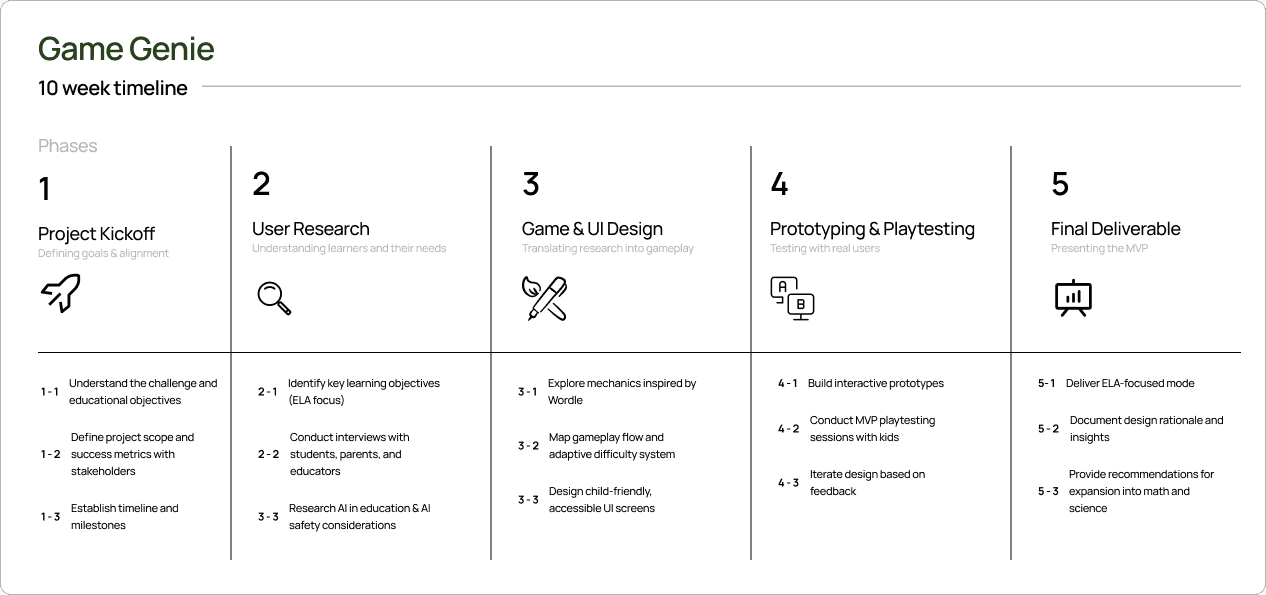
Before diving into design and development, our team created a project roadmap to guide progress, set realistic deadlines, and keep everyone accountable. To ensure clarity across stakeholders and engineering, we established a timeline in detail to align on expectations.
The roadmap moved through several phases: starting with user research and playtesting, then transitioning into gameplay design, prototype development, and MVP testing. Weekly syns kept the team connected, providing regular opportunities to share feedback, track milestones, and refine the product.
Initial Roadmap
Before diving into design and development, our team created a project roadmap to guide progress, set realistic deadlines, and keep everyone accountable. To ensure clarity across stakeholders and engineering, we established a timeline in detail to align on expectations.
The roadmap moved through several phases: starting with user research and playtesting, then transitioning into gameplay design, prototype development, and MVP testing. Weekly syns kept the team connected, providing regular opportunities to share feedback, track milestones, and refine the product.
Initial Roadmap
Before diving into design and development, our team created a project roadmap to guide progress, set realistic deadlines, and keep everyone accountable. To ensure clarity across stakeholders and engineering, we established a timeline in detail to align on expectations.
The roadmap moved through several phases: starting with user research and playtesting, then transitioning into gameplay design, prototype development, and MVP testing. Weekly syns kept the team connected, providing regular opportunities to share feedback, track milestones, and refine the product.
Literature Review
My research began with a review of peer-reviewed studies on artificial intelligence in education to understand both the opportunities and risks of AI-powered learning tools. Several key insights emerged that informed the design of Game Genie:
Personalization & Outcomes: Studies show that AI technologies such as intelligent tutoring systems and adaptive learning platforms significantly improve learning outcomes by tailoring instruction to each student's pace and needs.
Over-Reliance Risks: Research from the MIT Media Lab found that students who relied solely on AI tools like ChatGPT exhibited weaker neural connections and lower memory recall compared to those who worked without AI, highlighting the dangers of over-dependence.
Ethical & Safety Concerns: AI use in classrooms raises concerns about bias, data privacy, and inconsistent reliability. Since AI models are trained on massive datasets, they can perpetuate stereotypes, provide uneven feedback across groups of learners, and risks exposing sensitive student data.
These findings underscored the importance of designing Game Genie not just as a fun, adaptive game, but as a responsible educational tool, one that enhances learning through play while safeguarding against risks like over-reliance, misinformation, and equity gaps.
Literature Review
My research began with a review of peer-reviewed studies on artificial intelligence in education to understand both the opportunities and risks of AI-powered learning tools. Several key insights emerged that informed the design of Game Genie:
Personalization & Outcomes: Studies show that AI technologies such as intelligent tutoring systems and adaptive learning platforms significantly improve learning outcomes by tailoring instruction to each student's pace and needs.
Over-Reliance Risks: Research from the MIT Media Lab found that students who relied solely on AI tools like ChatGPT exhibited weaker neural connections and lower memory recall compared to those who worked without AI, highlighting the dangers of over-dependence.
Ethical & Safety Concerns: AI use in classrooms raises concerns about bias, data privacy, and inconsistent reliability. Since AI models are trained on massive datasets, they can perpetuate stereotypes, provide uneven feedback across groups of learners, and risks exposing sensitive student data.
These findings underscored the importance of designing Game Genie not just as a fun, adaptive game, but as a responsible educational tool, one that enhances learning through play while safeguarding against risks like over-reliance, misinformation, and equity gaps.
Literature Review
My research began with a review of peer-reviewed studies on artificial intelligence in education to understand both the opportunities and risks of AI-powered learning tools. Several key insights emerged that informed the design of Game Genie:
Personalization & Outcomes: Studies show that AI technologies such as intelligent tutoring systems and adaptive learning platforms significantly improve learning outcomes by tailoring instruction to each student's pace and needs.
Over-Reliance Risks: Research from the MIT Media Lab found that students who relied solely on AI tools like ChatGPT exhibited weaker neural connections and lower memory recall compared to those who worked without AI, highlighting the dangers of over-dependence.
Ethical & Safety Concerns: AI use in classrooms raises concerns about bias, data privacy, and inconsistent reliability. Since AI models are trained on massive datasets, they can perpetuate stereotypes, provide uneven feedback across groups of learners, and risks exposing sensitive student data.
These findings underscored the importance of designing Game Genie not just as a fun, adaptive game, but as a responsible educational tool, one that enhances learning through play while safeguarding against risks like over-reliance, misinformation, and equity gaps.
User Research & Insights
Understanding how kids learning and where they lose interest was central to shaping Game Genie. Since the goal was to design a tool that made vocabulary practice fun and accessible, the research focused on the real experiences of students, parents, and educators. This helped ensure the game would not only be engaging, but also effective in reinforcing classroom learning.
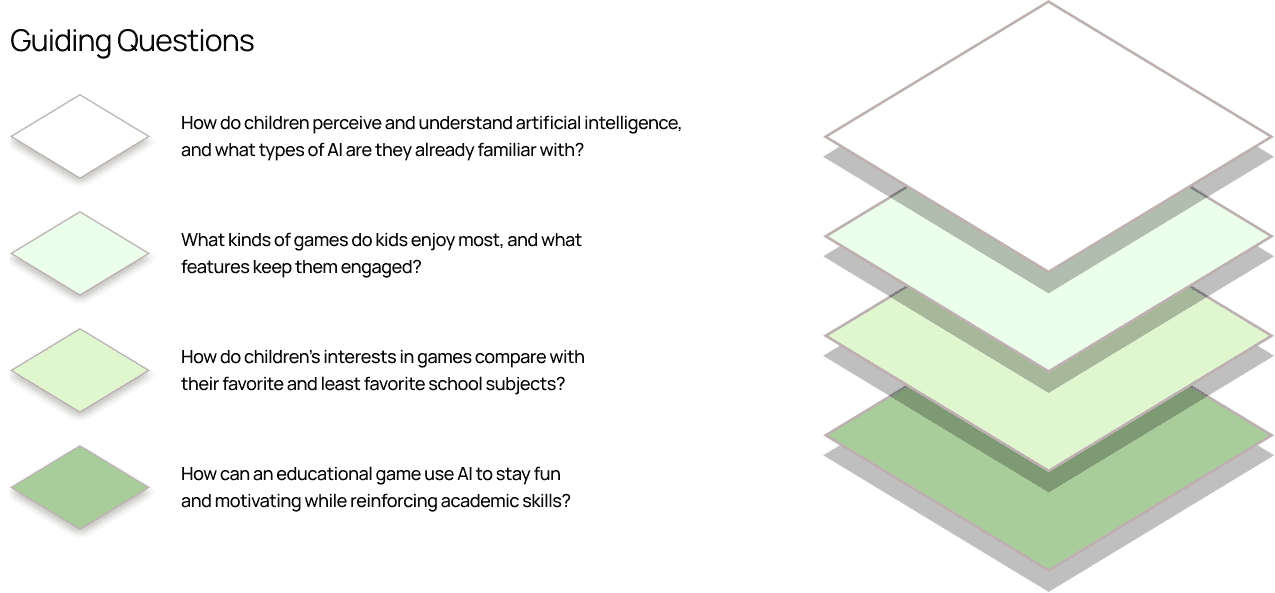
To guide our efforts, we explored several key questions:
User Research & Insights
Understanding how kids learning and where they lose interest was central to shaping Game Genie. Since the goal was to design a tool that made vocabulary practice fun and accessible, the research focused on the real experiences of students, parents, and educators. This helped ensure the game would not only be engaging, but also effective in reinforcing classroom learning.
To guide our efforts, we explored several key questions:
User Research & Insights
Understanding how kids learning and where they lose interest was central to shaping Game Genie. Since the goal was to design a tool that made vocabulary practice fun and accessible, the research focused on the real experiences of students, parents, and educators. This helped ensure the game would not only be engaging, but also effective in reinforcing classroom learning.
To guide our efforts, we explored several key questions:
In order to better understand how children engage with both games and learning, we conducted surveys and short interviews with students across elementary school grades. Participants included kids with little exposure to AI as well as those already familiar with tools like Siri, Alexa, or ChatGPT. These conversations gave us valuable insights into students' perceptions of AI, their gaming habits, and their preferences in school subjects:
AI Awareness: Kids described AI as "a smart robot" or "like Google," but noted it makes mistakes and can be misused for cheating.
Game Preferences: 88.9% enjoy running/jumping games, 77.8% prefer playing with friends, and 55.6& like puzzle/brain games.
Favorite Games: Popular choices included Fortnite, Roblox, FIFA, and Subway Surfers —all featuring progression, rewards, and social play.
Engagement Drivers: Students valued challenge, excitement, and customization, with rewards like XP, levels, and coins keeping them motivated.
In order to better understand how children engage with both games and learning, we conducted surveys and short interviews with students across elementary school grades. Participants included kids with little exposure to AI as well as those already familiar with tools like Siri, Alexa, or ChatGPT. These conversations gave us valuable insights into students' perceptions of AI, their gaming habits, and their preferences in school subjects:
AI Awareness: Kids described AI as "a smart robot" or "like Google," but noted it makes mistakes and can be misused for cheating.
Game Preferences: 88.9% enjoy running/jumping games, 77.8% prefer playing with friends, and 55.6& like puzzle/brain games.
Favorite Games: Popular choices included Fortnite, Roblox, FIFA, and Subway Surfers —all featuring progression, rewards, and social play.
Engagement Drivers: Students valued challenge, excitement, and customization, with rewards like XP, levels, and coins keeping them motivated.
In order to better understand how children engage with both games and learning, we conducted surveys and short interviews with students across elementary school grades. Participants included kids with little exposure to AI as well as those already familiar with tools like Siri, Alexa, or ChatGPT. These conversations gave us valuable insights into students' perceptions of AI, their gaming habits, and their preferences in school subjects:
AI Awareness: Kids described AI as "a smart robot" or "like Google," but noted it makes mistakes and can be misused for cheating.
Game Preferences: 88.9% enjoy running/jumping games, 77.8% prefer playing with friends, and 55.6& like puzzle/brain games.
Favorite Games: Popular choices included Fortnite, Roblox, FIFA, and Subway Surfers —all featuring progression, rewards, and social play.
Engagement Drivers: Students valued challenge, excitement, and customization, with rewards like XP, levels, and coins keeping them motivated.
Key Concept:
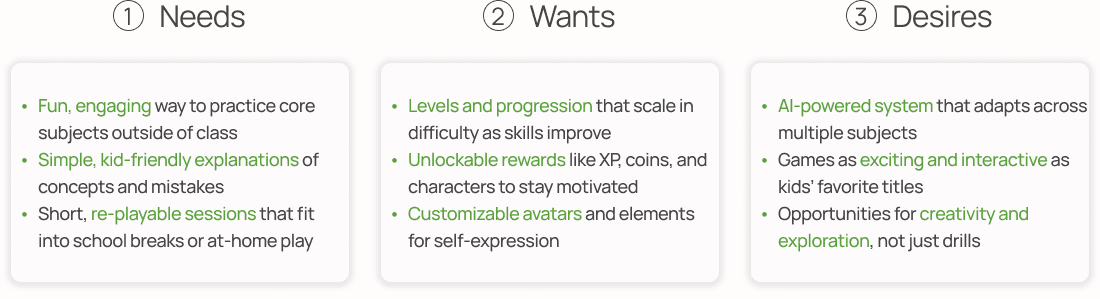
One of the most surprising takeaways from our research was that kids were not opposed to learning games, as long as the gameplay came first. While we initially assumed that students would prefer purely competitive games, survey and interview responses revealed that learning could be enjoyable when it was integrated as a feature rather than the main focus. Kids valued challenge, progression, and fun mechanics like rewards or customization, and were open to academic content so long as it didn't overshadow play. This insight shifted our design approach: instead of building "an educational game," we aimed to create a great game that also teaches.
Key Concept:
One of the most surprising takeaways from our research was that kids were not opposed to learning games, as long as the gameplay came first. While we initially assumed that students would prefer purely competitive games, survey and interview responses revealed that learning could be enjoyable when it was integrated as a feature rather than the main focus. Kids valued challenge, progression, and fun mechanics like rewards or customization, and were open to academic content so long as it didn't overshadow play. This insight shifted our design approach: instead of building "an educational game," we aimed to create a great game that also teaches.
Key Concept:
One of the most surprising takeaways from our research was that kids were not opposed to learning games, as long as the gameplay came first. While we initially assumed that students would prefer purely competitive games, survey and interview responses revealed that learning could be enjoyable when it was integrated as a feature rather than the main focus. Kids valued challenge, progression, and fun mechanics like rewards or customization, and were open to academic content so long as it didn't overshadow play. This insight shifted our design approach: instead of building "an educational game," we aimed to create a great game that also teaches.
Ideation & Low-Fidelity Design
I began by analyzing the games kids said they liked the most — from Fortnite and Roblox to Toca World and Subway Surfers. Looking closely at their similarities in mechanics, color palettes, and reward systems, we identified what made them engaging and how those elements could translate into a learning experience. At the same time, we explored existing games like Spelling Bee, 20 Questions, and Scrabble, asking how these formats could be enhanced with AI to support classroom learning.
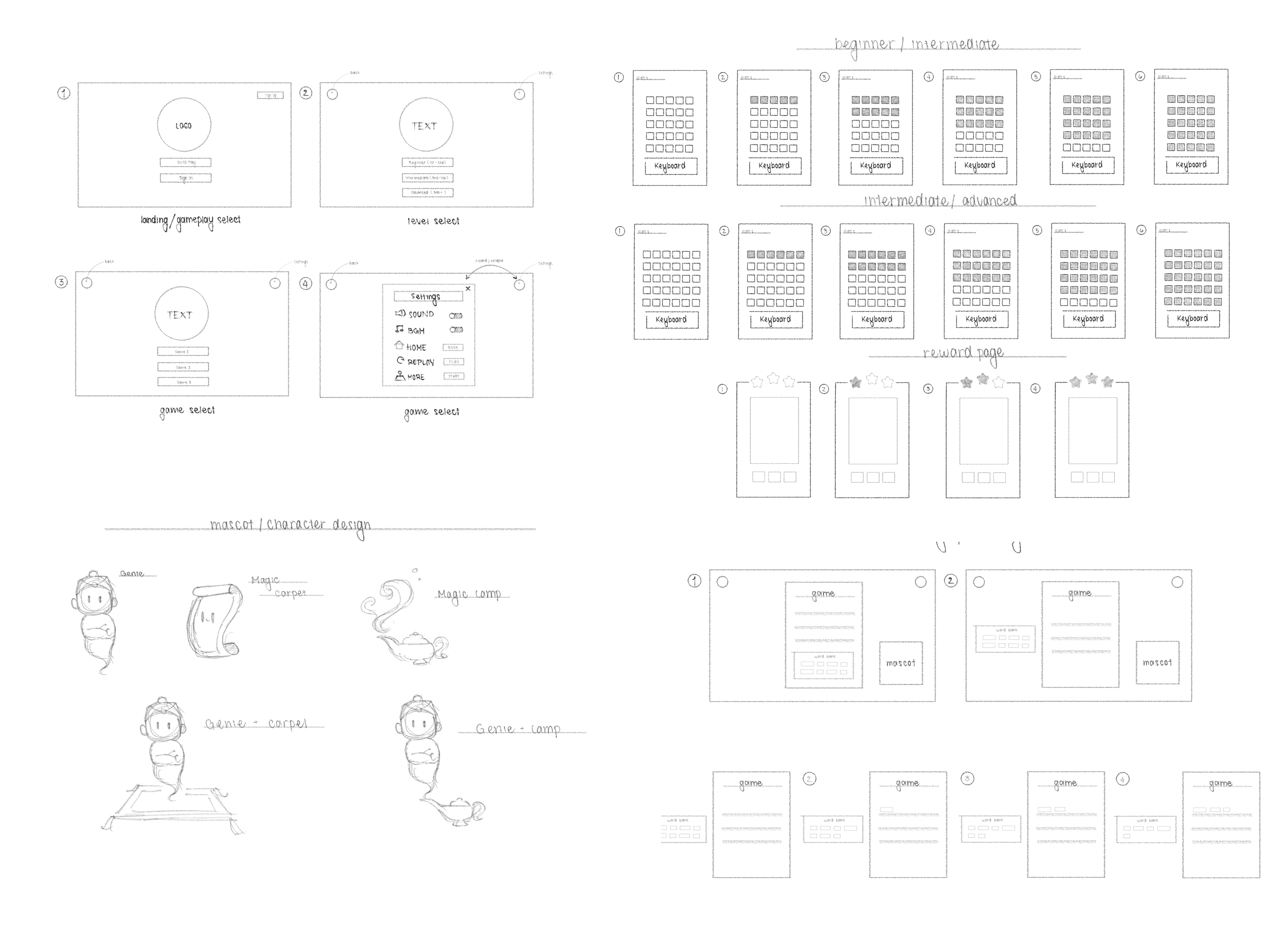
Since English Language arts was our first focus, we ultimately settled on Wordle as the core inspiration, but expanded it into a tool that not only reinforces spelling but also teaches word meanings and sentence-building practice. To frame the direction, I wrote a project proposal outlining how AI could personalize gameplay, adapt difficulty, and provide real-time hints. From there, I sketched low-fidelity mockups to visualize key features, from an integrated chatbot for smart hints to layouts for word challenges and vocabulary practice. These early concepts helped us refine the gameplay loop and imagine how Game Genie could scale to other subjects in the future.
Ideation & Low-Fidelity Design
I began by analyzing the games kids said they liked the most — from Fortnite and Roblox to Toca World and Subway Surfers. Looking closely at their similarities in mechanics, color palettes, and reward systems, we identified what made them engaging and how those elements could translate into a learning experience. At the same time, we explored existing games like Spelling Bee, 20 Questions, and Scrabble, asking how these formats could be enhanced with AI to support classroom learning.
Since English Language arts was our first focus, we ultimately settled on Wordle as the core inspiration, but expanded it into a tool that not only reinforces spelling but also teaches word meanings and sentence-building practice. To frame the direction, I wrote a project proposal outlining how AI could personalize gameplay, adapt difficulty, and provide real-time hints. From there, I sketched low-fidelity mockups to visualize key features, from an integrated chatbot for smart hints to layouts for word challenges and vocabulary practice. These early concepts helped us refine the gameplay loop and imagine how Game Genie could scale to other subjects in the future.
Ideation & Low-Fidelity Design
I began by analyzing the games kids said they liked the most — from Fortnite and Roblox to Toca World and Subway Surfers. Looking closely at their similarities in mechanics, color palettes, and reward systems, we identified what made them engaging and how those elements could translate into a learning experience. At the same time, we explored existing games like Spelling Bee, 20 Questions, and Scrabble, asking how these formats could be enhanced with AI to support classroom learning.
Since English Language arts was our first focus, we ultimately settled on Wordle as the core inspiration, but expanded it into a tool that not only reinforces spelling but also teaches word meanings and sentence-building practice. To frame the direction, I wrote a project proposal outlining how AI could personalize gameplay, adapt difficulty, and provide real-time hints. From there, I sketched low-fidelity mockups to visualize key features, from an integrated chatbot for smart hints to layouts for word challenges and vocabulary practice. These early concepts helped us refine the gameplay loop and imagine how Game Genie could scale to other subjects in the future.
Information Architecture
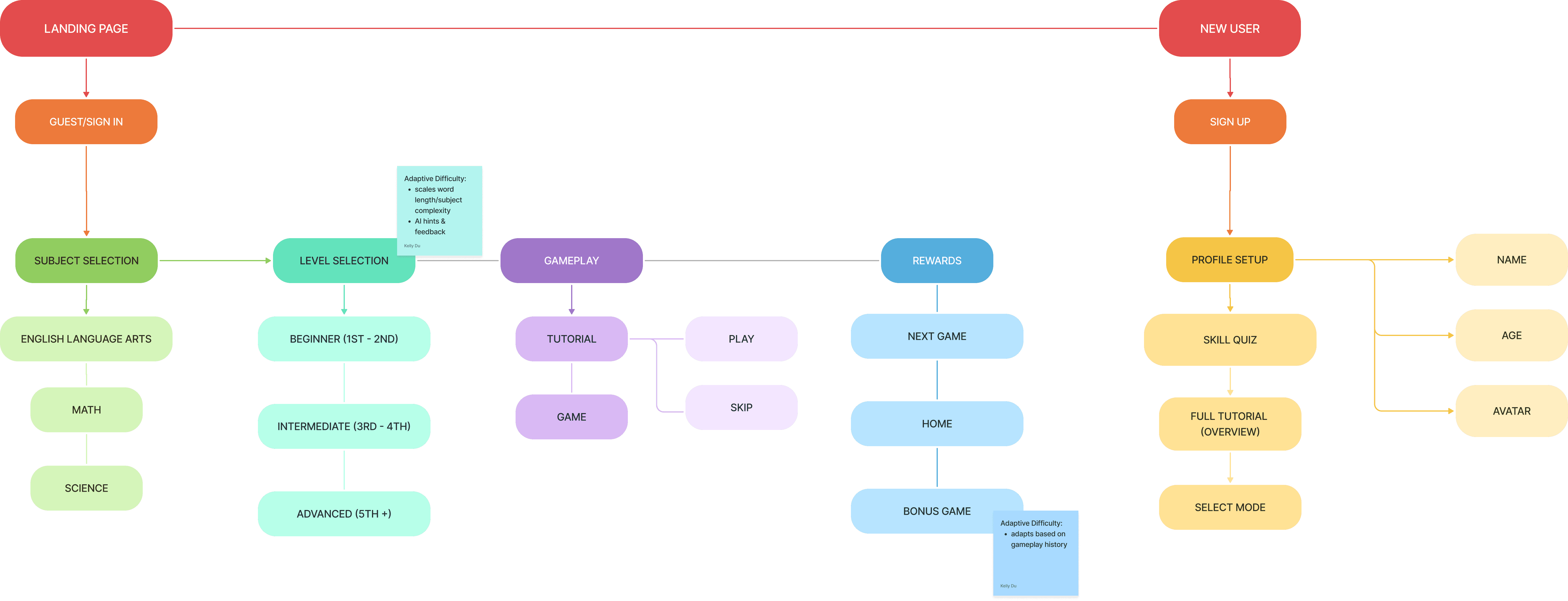
To bring clarity to how kids would experience the game, I mapped out the user journey from onboarding through gameplay progression. A flowchart was created to visualize each step, beginning with selecting a subject area and moving through word challenges, hints, rewards, and review opportunities.
This process helped define the core gameplay loop: play, learn, earn rewards, and progression, while ensuring that navigation remained simple and intuitive for young learners. By visualizing the entire flow, we were able to refine where learning moments should appear, how rewards were distributed, and how features like adaptive difficulty and AI-powered hints fit seamlessly into the experience.
Information Architecture
To bring clarity to how kids would experience the game, I mapped out the user journey from onboarding through gameplay progression. A flowchart was created to visualize each step, beginning with selecting a subject area and moving through word challenges, hints, rewards, and review opportunities.
This process helped define the core gameplay loop: play, learn, earn rewards, and progression, while ensuring that navigation remained simple and intuitive for young learners. By visualizing the entire flow, we were able to refine where learning moments should appear, how rewards were distributed, and how features like adaptive difficulty and AI-powered hints fit seamlessly into the experience.
Information Architecture
To bring clarity to how kids would experience the game, I mapped out the user journey from onboarding through gameplay progression. A flowchart was created to visualize each step, beginning with selecting a subject area and moving through word challenges, hints, rewards, and review opportunities.
This process helped define the core gameplay loop: play, learn, earn rewards, and progression, while ensuring that navigation remained simple and intuitive for young learners. By visualizing the entire flow, we were able to refine where learning moments should appear, how rewards were distributed, and how features like adaptive difficulty and AI-powered hints fit seamlessly into the experience.
Visual Direction
Drawing from survey responses and interviews, we looked closely at the visual language, color palettes, and core mechanics of the game student already loved. Our goal was to translate these engaging elements into an experience that could support learning without losing its sense of play.
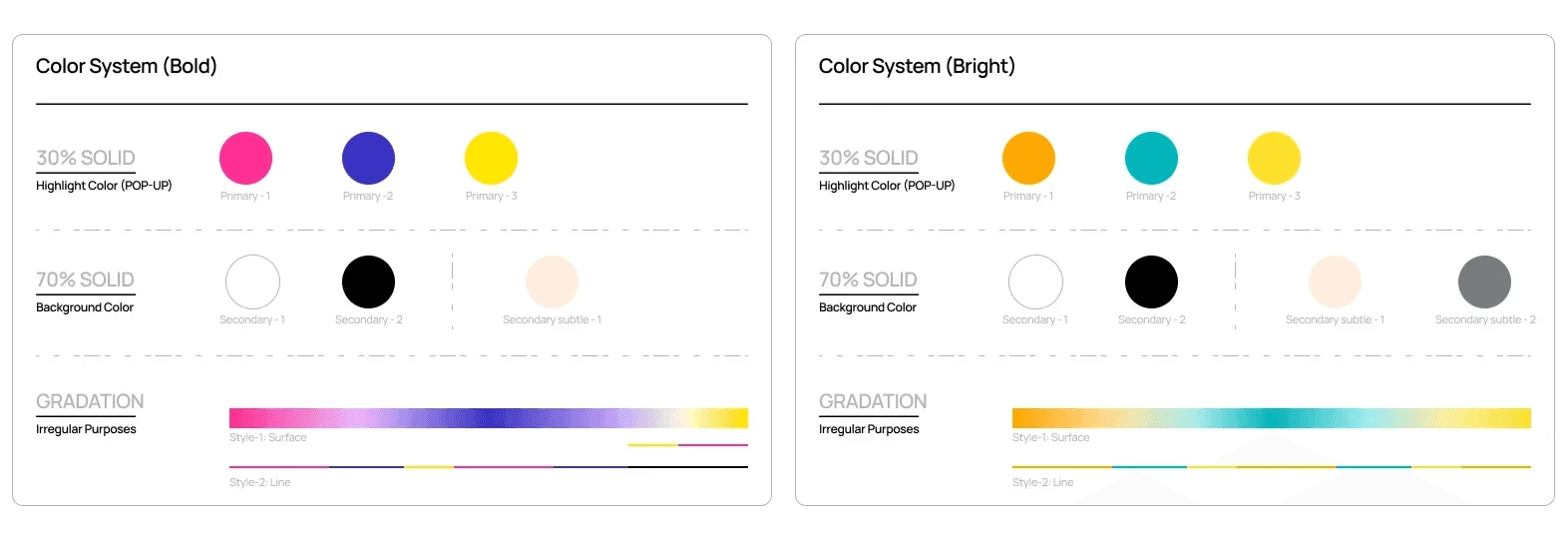
Early explorations included moodboards and two distinct design directions: one that leaned into bold, energetic colors inspired by arcade-style games, and another that used brighter, more primary tones to feel playful yet approachable for younger audiences.
To validate these directions, we asked students which palette they preferred. Responses revealed a strong pull toward the brighter, approachable palette, which felt familiar and inviting compared to the bold arcade-inspired theme.
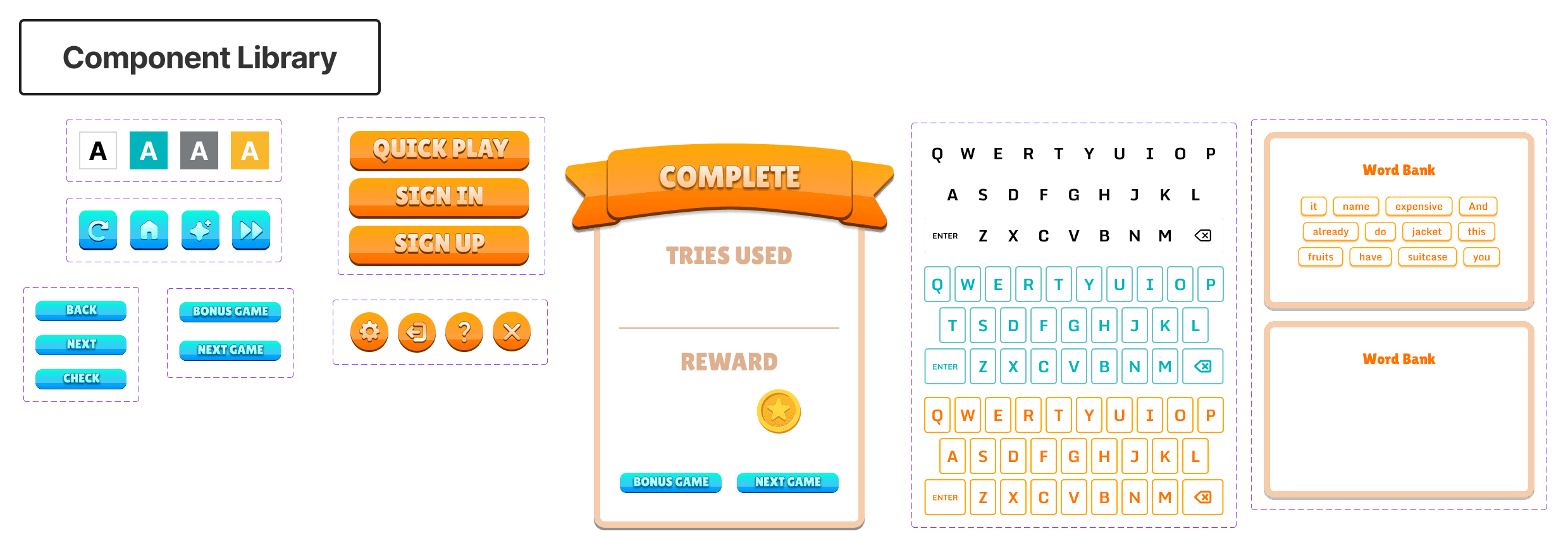
Alongside these visual explorations, we began defining core UI components such as buttons, navigation bars, and progress indicators, ensuring that they were accessible, readable, and simple enough for young users.
Visual Direction
Drawing from survey responses and interviews, we looked closely at the visual language, color palettes, and core mechanics of the game student already loved. Our goal was to translate these engaging elements into an experience that could support learning without losing its sense of play.
Early explorations included moodboards and two distinct design directions: one that leaned into bold, energetic colors inspired by arcade-style games, and another that used brighter, more primary tones to feel playful yet approachable for younger audiences.
To validate these directions, we asked students which palette they preferred. Responses revealed a strong pull toward the brighter, approachable palette, which felt familiar and inviting compared to the bold arcade-inspired theme.
Alongside these visual explorations, we began defining core UI components such as buttons, navigation bars, and progress indicators, ensuring that they were accessible, readable, and simple enough for young users.
Visual Direction
Drawing from survey responses and interviews, we looked closely at the visual language, color palettes, and core mechanics of the game student already loved. Our goal was to translate these engaging elements into an experience that could support learning without losing its sense of play.
Early explorations included moodboards and two distinct design directions: one that leaned into bold, energetic colors inspired by arcade-style games, and another that used brighter, more primary tones to feel playful yet approachable for younger audiences.
To validate these directions, we asked students which palette they preferred. Responses revealed a strong pull toward the brighter, approachable palette, which felt familiar and inviting compared to the bold arcade-inspired theme.
Alongside these visual explorations, we began defining core UI components such as buttons, navigation bars, and progress indicators, ensuring that they were accessible, readable, and simple enough for young users.
Design System Foundations
Alongside these visual explorations, we began defining core UI components such as buttons, navigation bars, and progress indicators, ensuring that they were accessible, readable, and simple enough for young users.
Establishing this design system early on gave us a foundation for consistency across screens and set clear guidelines for later iterations. Accessibility remained central, fonts were chosen for legibility, contrasts were carefully considered, and layouts prioritized clarity to minimize cognitive load.
Design System Foundations
Alongside these visual explorations, we began defining core UI components such as buttons, navigation bars, and progress indicators, ensuring that they were accessible, readable, and simple enough for young users.
Establishing this design system early on gave us a foundation for consistency across screens and set clear guidelines for later iterations. Accessibility remained central, fonts were chosen for legibility, contrasts were carefully considered, and layouts prioritized clarity to minimize cognitive load.
Design System Foundations
Alongside these visual explorations, we began defining core UI components such as buttons, navigation bars, and progress indicators, ensuring that they were accessible, readable, and simple enough for young users.
Establishing this design system early on gave us a foundation for consistency across screens and set clear guidelines for later iterations. Accessibility remained central, fonts were chosen for legibility, contrasts were carefully considered, and layouts prioritized clarity to minimize cognitive load.
Iteration & Prototyping
With the design system established, we moved into mid-fidelity wireframes and prototypes, translating our early sketches into interactive flows that could be tested. These wireframes quickly surfaced issues in the onboarding process: headings were too small, text blended into backgrounds, and CTA buttons lacked consistency across screens.
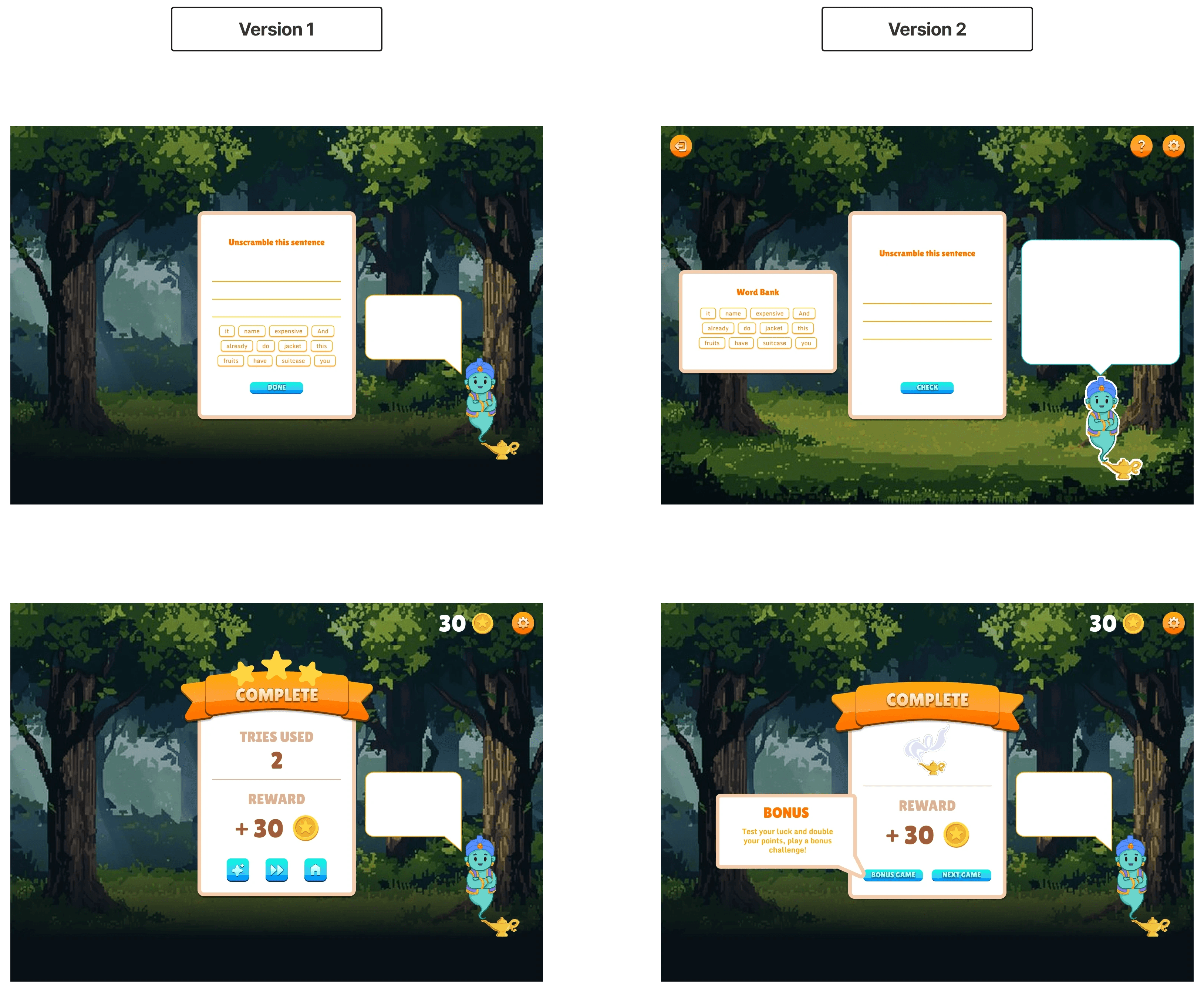
In Version 1, we addressed these problems by introducing extra-large headings to clarify steps in the flow, increasing text size for readability, and unifying CTA button styles to improve consistency. While these updates made the experience clearer, some areas still felt redundant or visually heavy.
In Version 2, further refinements were made after testing the prototype with kids. Hints were made more visible to support gameplay, the rewards page was simplified to reduce reduce redundancy, and CTAs were streamlined to feel more natural and intuitive. These changes created a more polished, playful flow while keeping the focus on what mattered most, balancing learning with engaging gameplay.
Iteration & Prototyping
With the design system established, we moved into mid-fidelity wireframes and prototypes, translating our early sketches into interactive flows that could be tested. These wireframes quickly surfaced issues in the onboarding process: headings were too small, text blended into backgrounds, and CTA buttons lacked consistency across screens.
In Version 1, we addressed these problems by introducing extra-large headings to clarify steps in the flow, increasing text size for readability, and unifying CTA button styles to improve consistency. While these updates made the experience clearer, some areas still felt redundant or visually heavy.
In Version 2, further refinements were made after testing the prototype with kids. Hints were made more visible to support gameplay, the rewards page was simplified to reduce reduce redundancy, and CTAs were streamlined to feel more natural and intuitive. These changes created a more polished, playful flow while keeping the focus on what mattered most, balancing learning with engaging gameplay.
Iteration & Prototyping
With the design system established, we moved into mid-fidelity wireframes and prototypes, translating our early sketches into interactive flows that could be tested. These wireframes quickly surfaced issues in the onboarding process: headings were too small, text blended into backgrounds, and CTA buttons lacked consistency across screens.
In Version 1, we addressed these problems by introducing extra-large headings to clarify steps in the flow, increasing text size for readability, and unifying CTA button styles to improve consistency. While these updates made the experience clearer, some areas still felt redundant or visually heavy.
In Version 2, further refinements were made after testing the prototype with kids. Hints were made more visible to support gameplay, the rewards page was simplified to reduce reduce redundancy, and CTAs were streamlined to feel more natural and intuitive. These changes created a more polished, playful flow while keeping the focus on what mattered most, balancing learning with engaging gameplay.
Finalizing the Design
As we moved closer to the MVP, the focus shifted from broad iterations to fine-tuning details that would shape the overall usability and feel of the game. The goal was to ensure that every screen felt intentional, accessible, and scalable for future subjects beyond ELA.
One of the biggest changes was in typography. While early prototypes experimented with highly gamified fonts to create excitement, these quickly proved overwhelming when used through the interface. In the final pass, playful typefaces were applied only where they added value, such as headings, rewards, or celebratory moments, while body text relied on clean, legible fonts to preserve clarity.
We also simplified profile customization to reduce unnecessary complexity. Instead of overwhelming kids with too many choices up front, options were pared down to focus on the most meaningful personalization features. Similarly, the visual hierarchy across pages was tightened, with clearer call-to-actions and streamlined layouts that prevented clutter.
These refinements created a design that felt both fun and approachable, while remaining grounded in principles of readability and usability. By stripping away distractions and standardizing core components, the final design system provided a strong foundation for both the MVP and future subject expansions.
Finalizing the Design
As we moved closer to the MVP, the focus shifted from broad iterations to fine-tuning details that would shape the overall usability and feel of the game. The goal was to ensure that every screen felt intentional, accessible, and scalable for future subjects beyond ELA.
One of the biggest changes was in typography. While early prototypes experimented with highly gamified fonts to create excitement, these quickly proved overwhelming when used through the interface. In the final pass, playful typefaces were applied only where they added value, such as headings, rewards, or celebratory moments, while body text relied on clean, legible fonts to preserve clarity.
We also simplified profile customization to reduce unnecessary complexity. Instead of overwhelming kids with too many choices up front, options were pared down to focus on the most meaningful personalization features. Similarly, the visual hierarchy across pages was tightened, with clearer call-to-actions and streamlined layouts that prevented clutter.
These refinements created a design that felt both fun and approachable, while remaining grounded in principles of readability and usability. By stripping away distractions and standardizing core components, the final design system provided a strong foundation for both the MVP and future subject expansions.
Finalizing the Design
As we moved closer to the MVP, the focus shifted from broad iterations to fine-tuning details that would shape the overall usability and feel of the game. The goal was to ensure that every screen felt intentional, accessible, and scalable for future subjects beyond ELA.
One of the biggest changes was in typography. While early prototypes experimented with highly gamified fonts to create excitement, these quickly proved overwhelming when used through the interface. In the final pass, playful typefaces were applied only where they added value, such as headings, rewards, or celebratory moments, while body text relied on clean, legible fonts to preserve clarity.
We also simplified profile customization to reduce unnecessary complexity. Instead of overwhelming kids with too many choices up front, options were pared down to focus on the most meaningful personalization features. Similarly, the visual hierarchy across pages was tightened, with clearer call-to-actions and streamlined layouts that prevented clutter.
These refinements created a design that felt both fun and approachable, while remaining grounded in principles of readability and usability. By stripping away distractions and standardizing core components, the final design system provided a strong foundation for both the MVP and future subject expansions.
Final Design
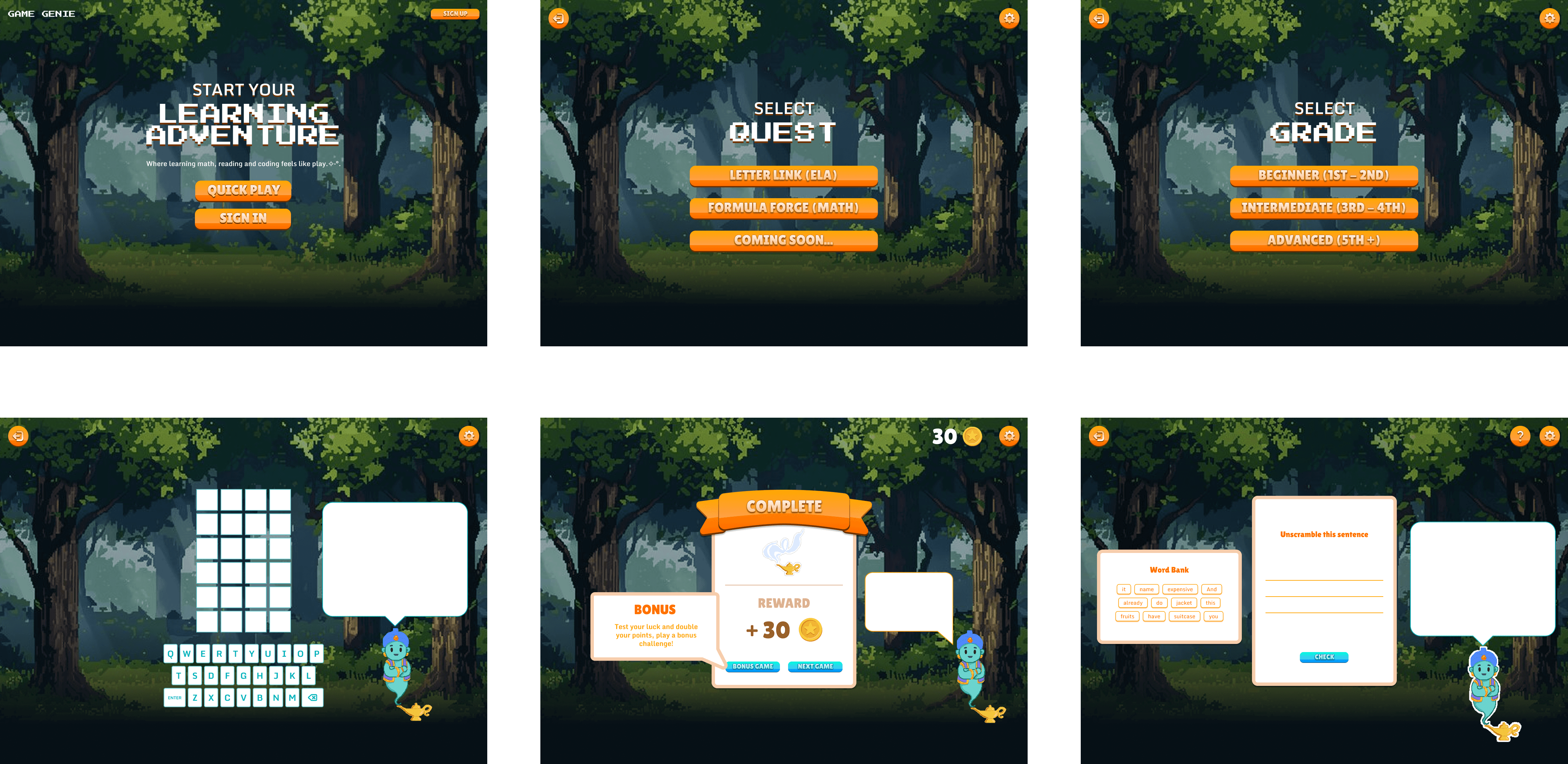
The final prototype brought together research, insights, and design iterations into a cohesive gameplay experience. Game Genie was designed to feel fun, intuitive, and learner-centered, giving kids an engaging way to practice core subjects while still feeling like they're just playing a game. By blending adaptive AI, playful mechanics, and accessible design, the final product balances lear
Final Design
The final prototype brought together research, insights, and design iterations into a cohesive gameplay experience. Game Genie was designed to feel fun, intuitive, and learner-centered, giving kids an engaging way to practice core subjects while still feeling like they're just playing a game. By blending adaptive AI, playful mechanics, and accessible design, the final product balances lear
Final Design
The final prototype brought together research, insights, and design iterations into a cohesive gameplay experience. Game Genie was designed to feel fun, intuitive, and learner-centered, giving kids an engaging way to practice core subjects while still feeling like they're just playing a game. By blending adaptive AI, playful mechanics, and accessible design, the final product balances lear
Project Takeaways
Building Game Genie was as much about the process of discovery as it was about the final product. One of the biggest lessons was the importance of challenging design assumptions, we expected kids to prefer purely competitive games and resist anything that felt educational. Instead, our research showed that learning games could be just as engaging, provided they offered challenge, rewards, and opportunities for self-expression and growth.
Another takeaway was the value of iteration and simplification. Early prototypes often tried to do too much, but by streamlining navigation, standardizing components, and focusing on the essentials, we created a product that was both accessible and scalable.
As the Product Designer and Researcher, I guided this process from early research through final design, shaping everything from the game flow to the UI components. This experience underscored how design thinking and product strategy come together, balancing user needs, playful mechanics, and long-term scalability.
Ultimately, this project reinforced the idea that designing for children requires balancing delight with clarity. Game Genie is not just an educational game, it is a playful companion that adapts to each child's needs, maing learning feel like an adventure rather than an assignment.
Project Takeaways
Building Game Genie was as much about the process of discovery as it was about the final product. One of the biggest lessons was the importance of challenging design assumptions, we expected kids to prefer purely competitive games and resist anything that felt educational. Instead, our research showed that learning games could be just as engaging, provided they offered challenge, rewards, and opportunities for self-expression and growth.
Another takeaway was the value of iteration and simplification. Early prototypes often tried to do too much, but by streamlining navigation, standardizing components, and focusing on the essentials, we created a product that was both accessible and scalable.
As the Product Designer and Researcher, I guided this process from early research through final design, shaping everything from the game flow to the UI components. This experience underscored how design thinking and product strategy come together, balancing user needs, playful mechanics, and long-term scalability.
Ultimately, this project reinforced the idea that designing for children requires balancing delight with clarity. Game Genie is not just an educational game, it is a playful companion that adapts to each child's needs, maing learning feel like an adventure rather than an assignment.
Project Takeaways
Building Game Genie was as much about the process of discovery as it was about the final product. One of the biggest lessons was the importance of challenging design assumptions, we expected kids to prefer purely competitive games and resist anything that felt educational. Instead, our research showed that learning games could be just as engaging, provided they offered challenge, rewards, and opportunities for self-expression and growth.
Another takeaway was the value of iteration and simplification. Early prototypes often tried to do too much, but by streamlining navigation, standardizing components, and focusing on the essentials, we created a product that was both accessible and scalable.
As the Product Designer and Researcher, I guided this process from early research through final design, shaping everything from the game flow to the UI components. This experience underscored how design thinking and product strategy come together, balancing user needs, playful mechanics, and long-term scalability.
Ultimately, this project reinforced the idea that designing for children requires balancing delight with clarity. Game Genie is not just an educational game, it is a playful companion that adapts to each child's needs, maing learning feel like an adventure rather than an assignment.
Ready to build something amazing?
I'd love to connect with you!
Ready to build something amazing?
I'd love to connect with you!
Ready to build something amazing?
I'd love to connect with you!