PulseCheck
Shaping an AI-powered health companion grounded in user research and product strategy to support post-visit care and patient understanding
Role
Product Manager & Researcher
Industry
AI in Healthcare
Duration
72 hours
Overview
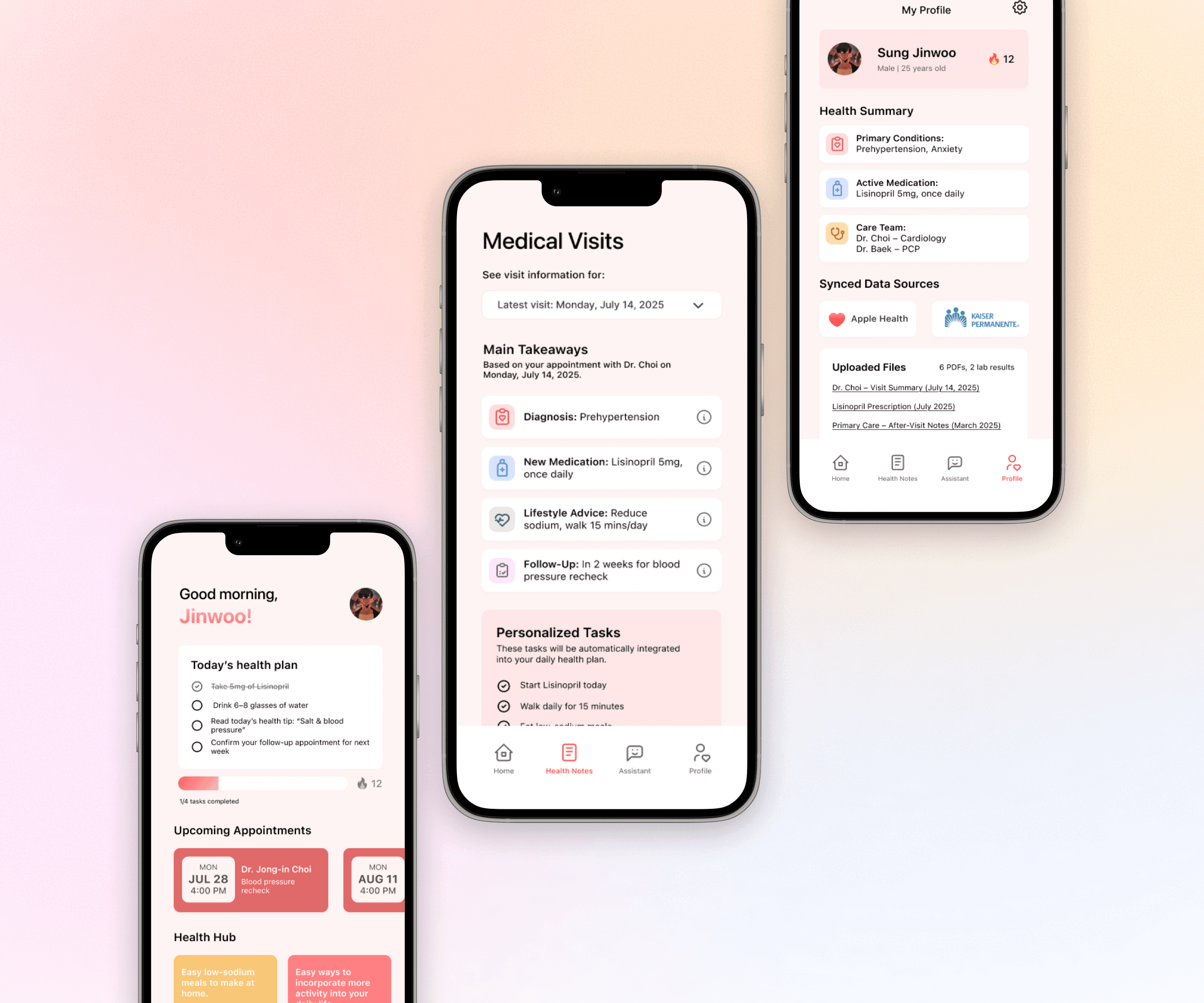
The journey began with a simple yet powerful question: How can we ensure that a patient's healthcare doesn't end when they leave the doctor's office? We knew that patients often walk out with an after-visit summary and a list of care instructions, but without a clear, actionable plan, that information can quickly get lost.
PulseCheck is an AI-powered digital health companion designed to improve patient engagement and outcomes after a medical visit. The app aims to empower patients to confidently manage their health journey and stay on track with their care.
The Problem
Healthcare doesn't end after the visit — but patients are often left with vague instructions and an improvised recovery plan, which can lead to confusion, missed steps, and preventable health setbacks. This is compounded by the fact that healthcare systems are currently overwhelmed, with rising demand outpacing the available supply of care. This creates a need for solutions that can scale to support patients outside of traditional clinical settings.
Overview
The journey began with a simple yet powerful question: How can we ensure that a patient's healthcare doesn't end when they leave the doctor's office? We knew that patients often walk out with an after-visit summary and a list of care instructions, but without a clear, actionable plan, that information can quickly get lost.
PulseCheck is an AI-powered digital health companion designed to improve patient engagement and outcomes after a medical visit. The app aims to empower patients to confidently manage their health journey and stay on track with their care.
The Problem
Healthcare doesn't end after the visit — but patients are often left with vague instructions and an improvised recovery plan, which can lead to confusion, missed steps, and preventable health setbacks. This is compounded by the fact that healthcare systems are currently overwhelmed, with rising demand outpacing the available supply of care. This creates a need for solutions that can scale to support patients outside of traditional clinical settings.
Overview
The journey began with a simple yet powerful question: How can we ensure that a patient's healthcare doesn't end when they leave the doctor's office? We knew that patients often walk out with an after-visit summary and a list of care instructions, but without a clear, actionable plan, that information can quickly get lost.
PulseCheck is an AI-powered digital health companion designed to improve patient engagement and outcomes after a medical visit. The app aims to empower patients to confidently manage their health journey and stay on track with their care.
The Problem
Healthcare doesn't end after the visit — but patients are often left with vague instructions and an improvised recovery plan, which can lead to confusion, missed steps, and preventable health setbacks. This is compounded by the fact that healthcare systems are currently overwhelmed, with rising demand outpacing the available supply of care. This creates a need for solutions that can scale to support patients outside of traditional clinical settings.
Defining the Scope
PulseCheck was designed as an AI-powered app to serve as a centralized hub for post-visit care. The key features the solution include:
Personalized Health Plan: An AI-generated daily wellness plan with achievable goals.
Smart Reminders: Automated reminders for medication adherence, appointments, and follow-up tasks.
AI-Summarized Visit Notes: The app distills medical notes in simple, actionable information and personalized care tasks.
In-App Health Hub: A source for curated, user-specific health tips and advice.
AI Assistant: A conversational assistant to help users understand lab results and schedule follow-ups.
Defining the Scope
PulseCheck was designed as an AI-powered app to serve as a centralized hub for post-visit care. The key features the solution include:
Personalized Health Plan: An AI-generated daily wellness plan with achievable goals.
Smart Reminders: Automated reminders for medication adherence, appointments, and follow-up tasks.
AI-Summarized Visit Notes: The app distills medical notes in simple, actionable information and personalized care tasks.
In-App Health Hub: A source for curated, user-specific health tips and advice.
AI Assistant: A conversational assistant to help users understand lab results and schedule follow-ups.
Defining the Scope
PulseCheck was designed as an AI-powered app to serve as a centralized hub for post-visit care. The key features the solution include:
Personalized Health Plan: An AI-generated daily wellness plan with achievable goals.
Smart Reminders: Automated reminders for medication adherence, appointments, and follow-up tasks.
AI-Summarized Visit Notes: The app distills medical notes in simple, actionable information and personalized care tasks.
In-App Health Hub: A source for curated, user-specific health tips and advice.
AI Assistant: A conversational assistant to help users understand lab results and schedule follow-ups.
Literature Review
Our research began with a literature review of 10 articles from peer-reviewed studies and healthcare journals to better understand the current landscape of patient care. The review yielded several key insights that validated our approach:
Patient Recall: Studies show that 40-80% of medical information is forgotten immediately after a visit, and nearly half of what is remembered is incorrect.
Systemic Overload: The demand for healthcare is outpacing the supply, with patients expecting smarter, faster solutions than are currently available.
AI's Role: AI models have shown promise in identifying hidden health risks and augmenting, rather than replacing, human care.
Literature Review
Our research began with a literature review of 10 articles from peer-reviewed studies and healthcare journals to better understand the current landscape of patient care. The review yielded several key insights that validated our approach:
Patient Recall: Studies show that 40-80% of medical information is forgotten immediately after a visit, and nearly half of what is remembered is incorrect.
Systemic Overload: The demand for healthcare is outpacing the supply, with patients expecting smarter, faster solutions than are currently available.
AI's Role: AI models have shown promise in identifying hidden health risks and augmenting, rather than replacing, human care.
Literature Review
Our research began with a literature review of 10 articles from peer-reviewed studies and healthcare journals to better understand the current landscape of patient care. The review yielded several key insights that validated our approach:
Patient Recall: Studies show that 40-80% of medical information is forgotten immediately after a visit, and nearly half of what is remembered is incorrect.
Systemic Overload: The demand for healthcare is outpacing the supply, with patients expecting smarter, faster solutions than are currently available.
AI's Role: AI models have shown promise in identifying hidden health risks and augmenting, rather than replacing, human care.
User Research & Insights
At the core of our process was empathy; we are designing to solve a problem or meet a need, and understanding the user's experience is essential to creating solutions that actually solve user problems.
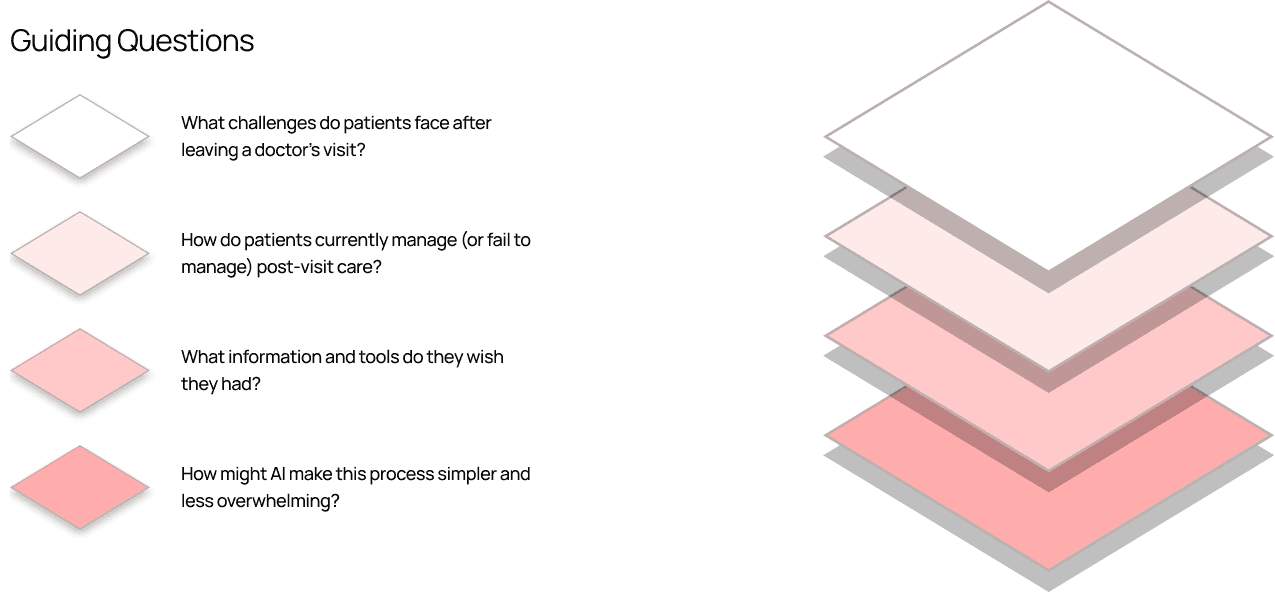
Here were several critical Questions that I considered:
User Research & Insights
At the core of our process was empathy; we are designing to solve a problem or meet a need, and understanding the user's experience is essential to creating solutions that actually solve user problems.
Here were several critical Questions that I considered:
User Research & Insights
At the core of our process was empathy; we are designing to solve a problem or meet a need, and understanding the user's experience is essential to creating solutions that actually solve user problems.
Here were several critical Questions that I considered:
To gain deeper insights into patient needs, I conducted interviews with several patients across a range of ages, health conditions, and recovery experiences. Participants included younger adults focused on preventative care as well as older patients managing chronic illnesses. These interviews allowed us to better understand patients expectations, challenges, and preferences for a post-visit care app that could meet their unique needs:
Information Gaps: 57% of patients often forget what they were told during their visits, and 50% lacked confidence in their ability to remember instructions.
Unreliable Sources: 29% of participants admitted to searching online for clarification instead of following up with their doctor.
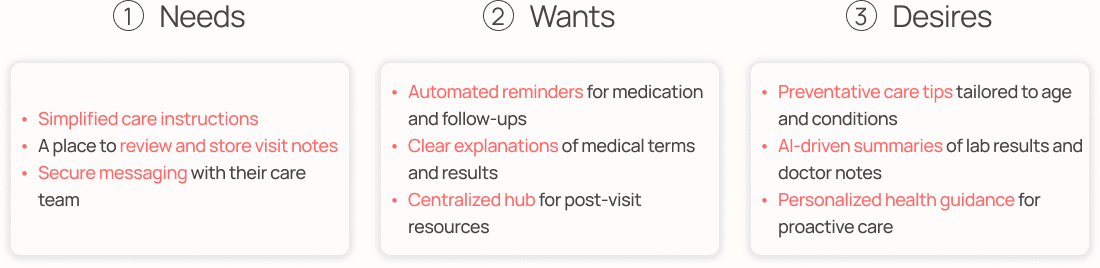
The interview also revealed a strong demand for a digital solution, with 93% of respondents expressing interest in a post-visit care app. The top three most desired features were simplified care instructions (78.6%), a place to review and store visit notes (71.4%), and secure messaging with their care team (64.3%).
These findings shaped our understanding of user needs, wants, and desires:
To gain deeper insights into patient needs, I conducted interviews with several patients across a range of ages, health conditions, and recovery experiences. Participants included younger adults focused on preventative care as well as older patients managing chronic illnesses. These interviews allowed us to better understand patients expectations, challenges, and preferences for a post-visit care app that could meet their unique needs:
Information Gaps: 57% of patients often forget what they were told during their visits, and 50% lacked confidence in their ability to remember instructions.
Unreliable Sources: 29% of participants admitted to searching online for clarification instead of following up with their doctor.
The interview also revealed a strong demand for a digital solution, with 93% of respondents expressing interest in a post-visit care app. The top three most desired features were simplified care instructions (78.6%), a place to review and store visit notes (71.4%), and secure messaging with their care team (64.3%).
These findings shaped our understanding of user needs, wants, and desires:
To gain deeper insights into patient needs, I conducted interviews with several patients across a range of ages, health conditions, and recovery experiences. Participants included younger adults focused on preventative care as well as older patients managing chronic illnesses. These interviews allowed us to better understand patients expectations, challenges, and preferences for a post-visit care app that could meet their unique needs:
Information Gaps: 57% of patients often forget what they were told during their visits, and 50% lacked confidence in their ability to remember instructions.
Unreliable Sources: 29% of participants admitted to searching online for clarification instead of following up with their doctor.
The interview also revealed a strong demand for a digital solution, with 93% of respondents expressing interest in a post-visit care app. The top three most desired features were simplified care instructions (78.6%), a place to review and store visit notes (71.4%), and secure messaging with their care team (64.3%).
These findings shaped our understanding of user needs, wants, and desires:
Key Concept:
One of the biggest takeaways from these interviews was the importance of avoiding design assumptions. Instead of relying on what we thought patients might want, the insights gained from real users revealed perspectives we hadn't considered. By listening to their needs, pain points, and motivations, we were able to challenge our initial ideas and validate later design choices. This process helped us avoid common pitfalls and ensured that PulseCheck was built to solve actual problems rather than perceived ones.
Key Concept:
One of the biggest takeaways from these interviews was the importance of avoiding design assumptions. Instead of relying on what we thought patients might want, the insights gained from real users revealed perspectives we hadn't considered. By listening to their needs, pain points, and motivations, we were able to challenge our initial ideas and validate later design choices. This process helped us avoid common pitfalls and ensured that PulseCheck was built to solve actual problems rather than perceived ones.
Key Concept:
One of the biggest takeaways from these interviews was the importance of avoiding design assumptions. Instead of relying on what we thought patients might want, the insights gained from real users revealed perspectives we hadn't considered. By listening to their needs, pain points, and motivations, we were able to challenge our initial ideas and validate later design choices. This process helped us avoid common pitfalls and ensured that PulseCheck was built to solve actual problems rather than perceived ones.
User Personas
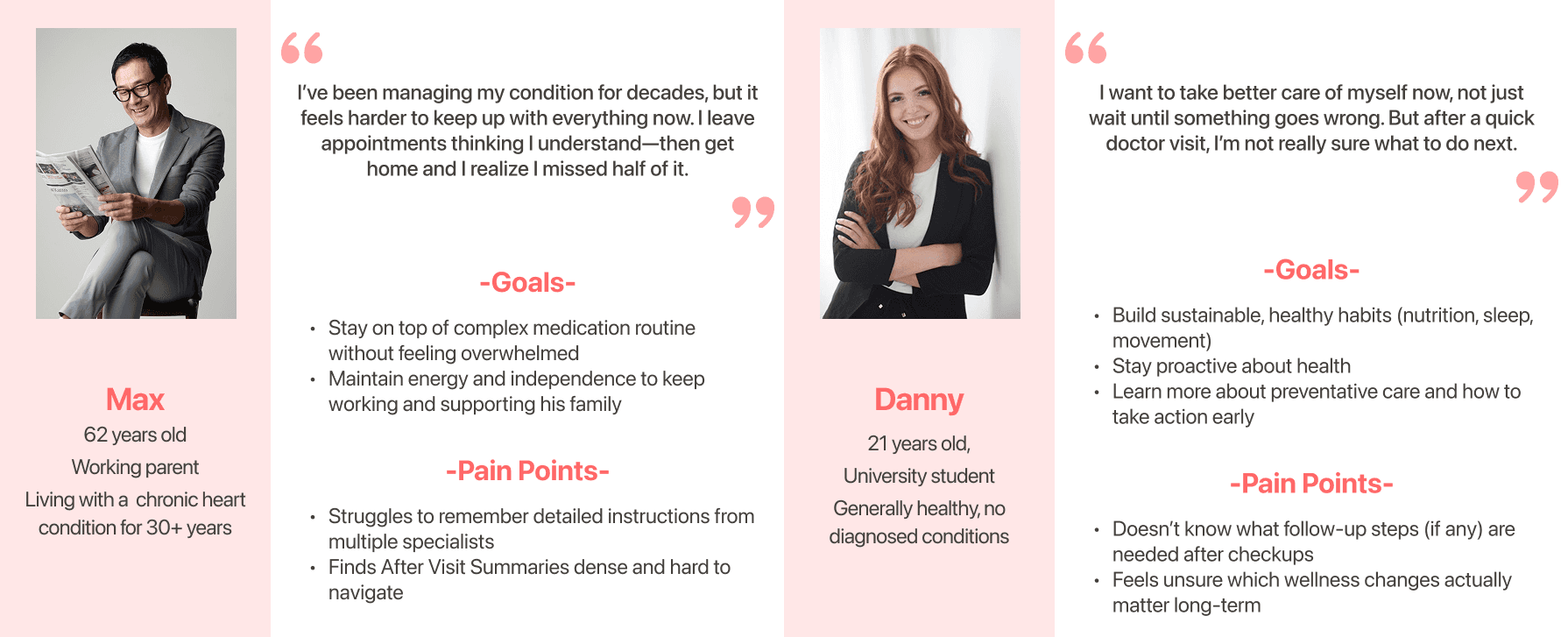
Based on this research, we created user personas to gain a deeper understanding of our target audience. These personas provided visual representations of our audience, which spans from chronic condition management to preventative care.
User Personas
Based on this research, we created user personas to gain a deeper understanding of our target audience. These personas provided visual representations of our audience, which spans from chronic condition management to preventative care.
User Personas
Based on this research, we created user personas to gain a deeper understanding of our target audience. These personas provided visual representations of our audience, which spans from chronic condition management to preventative care.
Market Research
In addition to user interviews, I conducted market research to better understand the opportunity space for PulseCheck and validate our product vision. This involved two approaches:
Competitive Analysis
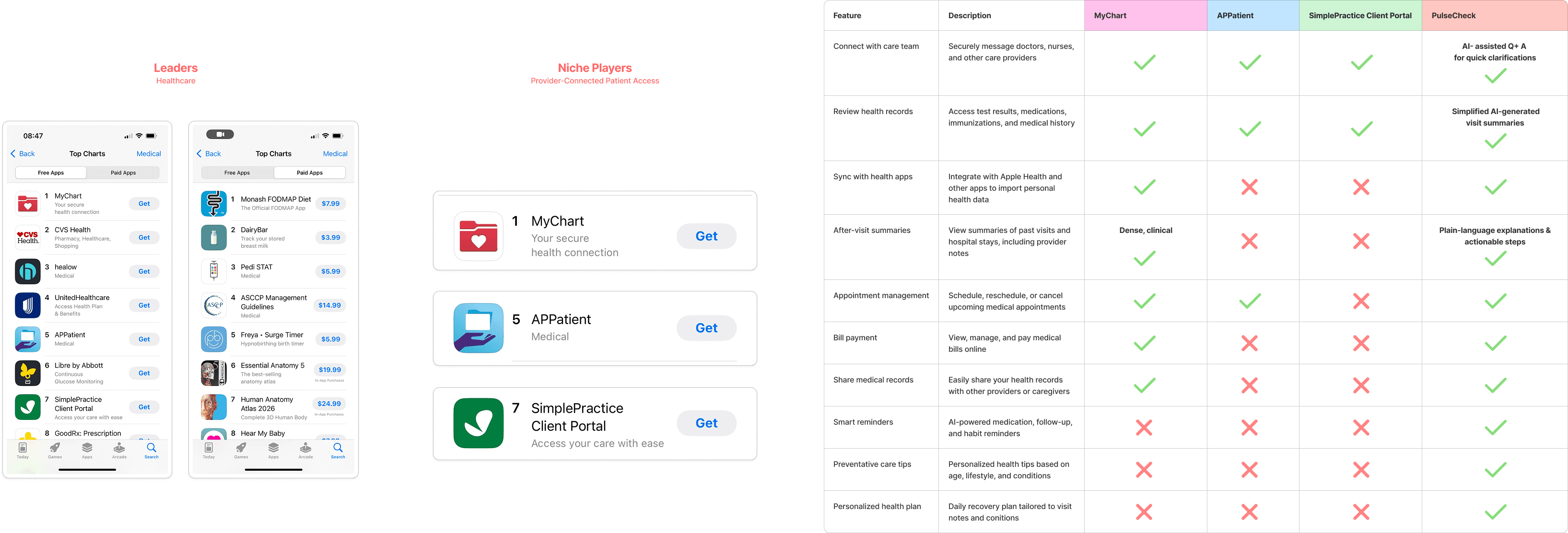
I reviewed healthcare apps such as MyChart, APPatient, and SimplePractice Client Portal to analyze their strengths and limitations. Which these apps provided useful record-keeping and medication reminders, most failed to address the emotional burden patients face post-visit. They were often dense, overly clinical, and lacked the proactive guidance users told us they wanted.
Market Research
In addition to user interviews, I conducted market research to better understand the opportunity space for PulseCheck and validate our product vision. This involved two approaches:
Competitive Analysis
I reviewed healthcare apps such as MyChart, APPatient, and SimplePractice Client Portal to analyze their strengths and limitations. Which these apps provided useful record-keeping and medication reminders, most failed to address the emotional burden patients face post-visit. They were often dense, overly clinical, and lacked the proactive guidance users told us they wanted.
Market Research
In addition to user interviews, I conducted market research to better understand the opportunity space for PulseCheck and validate our product vision. This involved two approaches:
Competitive Analysis
I reviewed healthcare apps such as MyChart, APPatient, and SimplePractice Client Portal to analyze their strengths and limitations. Which these apps provided useful record-keeping and medication reminders, most failed to address the emotional burden patients face post-visit. They were often dense, overly clinical, and lacked the proactive guidance users told us they wanted.
Key Insights
Current leaders like MyChart focus on record-keeping and provider communication but leave patients overwhelmed with dense summaries and fragmented care. PulseCheck bridges these gaps by adding AI-driven clarity, personalization, and preventative guidance — turning post-visit confusion into actionable recovery steps.
Key Insights
Current leaders like MyChart focus on record-keeping and provider communication but leave patients overwhelmed with dense summaries and fragmented care. PulseCheck bridges these gaps by adding AI-driven clarity, personalization, and preventative guidance — turning post-visit confusion into actionable recovery steps.
Key Insights
Current leaders like MyChart focus on record-keeping and provider communication but leave patients overwhelmed with dense summaries and fragmented care. PulseCheck bridges these gaps by adding AI-driven clarity, personalization, and preventative guidance — turning post-visit confusion into actionable recovery steps.
Market Sizing
To contextualize PulseCheck's potential, we analyzed the projected growth of AI in digital healthcare:
Market Sizing
To contextualize PulseCheck's potential, we analyzed the projected growth of AI in digital healthcare:
Market Sizing
To contextualize PulseCheck's potential, we analyzed the projected growth of AI in digital healthcare:
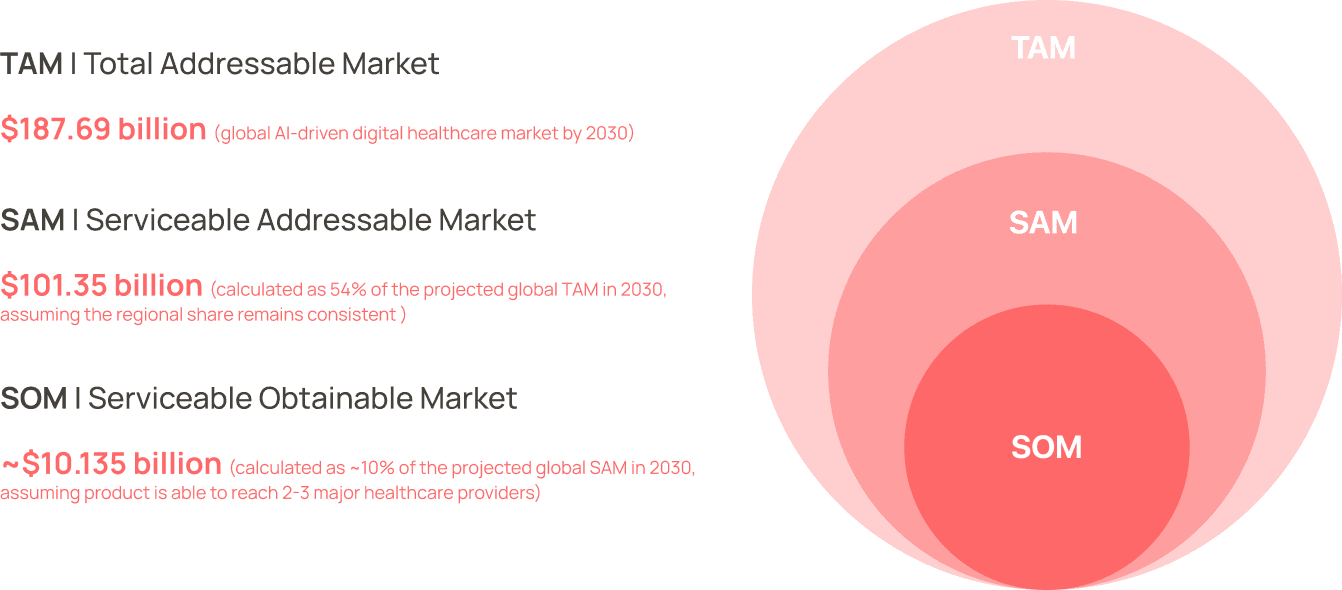
The scale of opportunity within digital health is immense, particularly for solutions that bridge the gap between post-visit care and patient empowerment. Even capturing a small percentage of the obtainable market represents billions in potential value, underscoring both the feasibility and scalability of PulseCheck
By aligning user pain points with this fast-growing market, PulseCheck is positioned not only as a patient-centered solution, but also as a strategically viable product in a sector where healthcare providers, insurers, and patients are increasingly seeking new tools to reduce costs, improve outcomes, and streamline communication.
The scale of opportunity within digital health is immense, particularly for solutions that bridge the gap between post-visit care and patient empowerment. Even capturing a small percentage of the obtainable market represents billions in potential value, underscoring both the feasibility and scalability of PulseCheck
By aligning user pain points with this fast-growing market, PulseCheck is positioned not only as a patient-centered solution, but also as a strategically viable product in a sector where healthcare providers, insurers, and patients are increasingly seeking new tools to reduce costs, improve outcomes, and streamline communication.
The scale of opportunity within digital health is immense, particularly for solutions that bridge the gap between post-visit care and patient empowerment. Even capturing a small percentage of the obtainable market represents billions in potential value, underscoring both the feasibility and scalability of PulseCheck
By aligning user pain points with this fast-growing market, PulseCheck is positioned not only as a patient-centered solution, but also as a strategically viable product in a sector where healthcare providers, insurers, and patients are increasingly seeking new tools to reduce costs, improve outcomes, and streamline communication.
Information Architecture
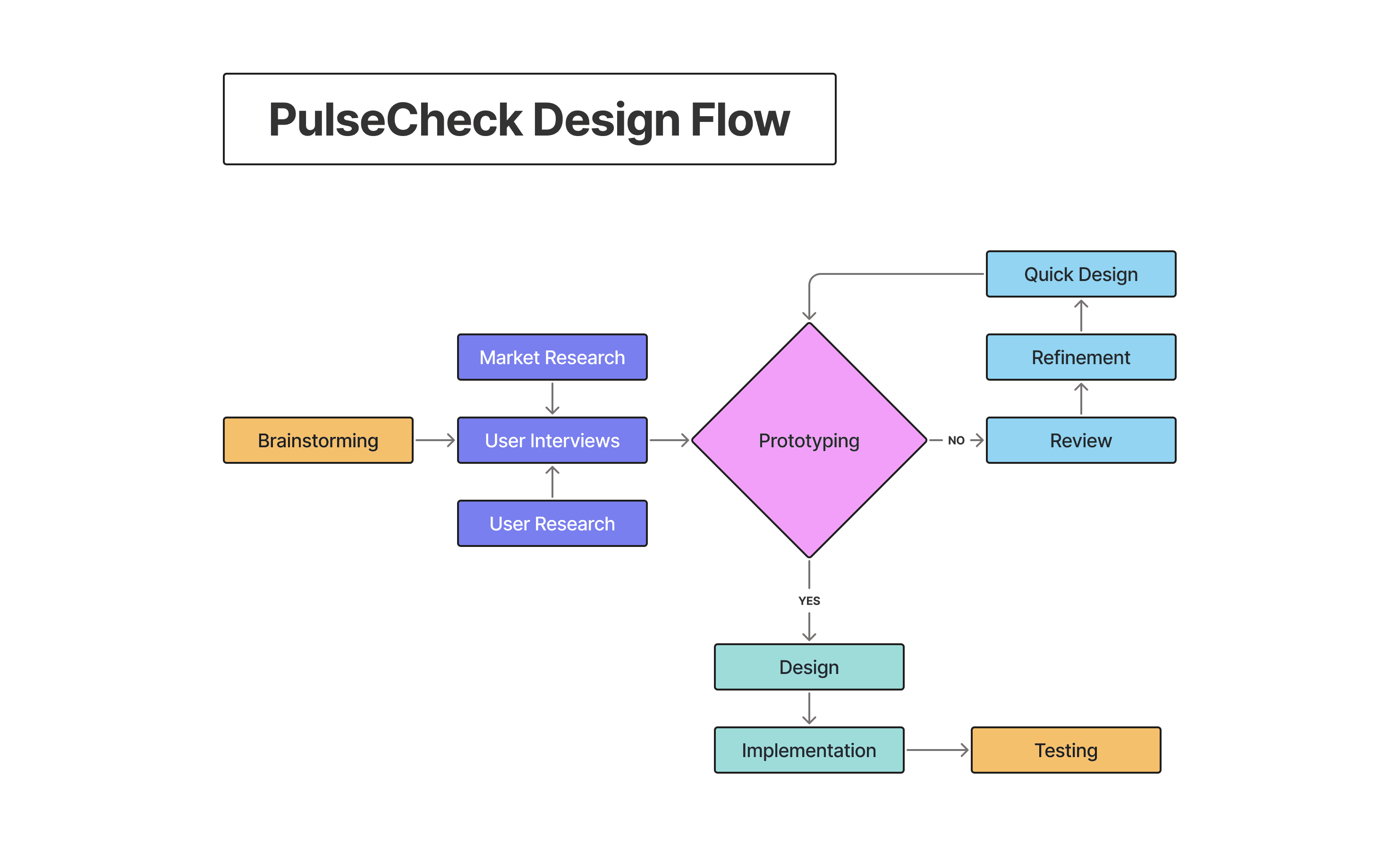
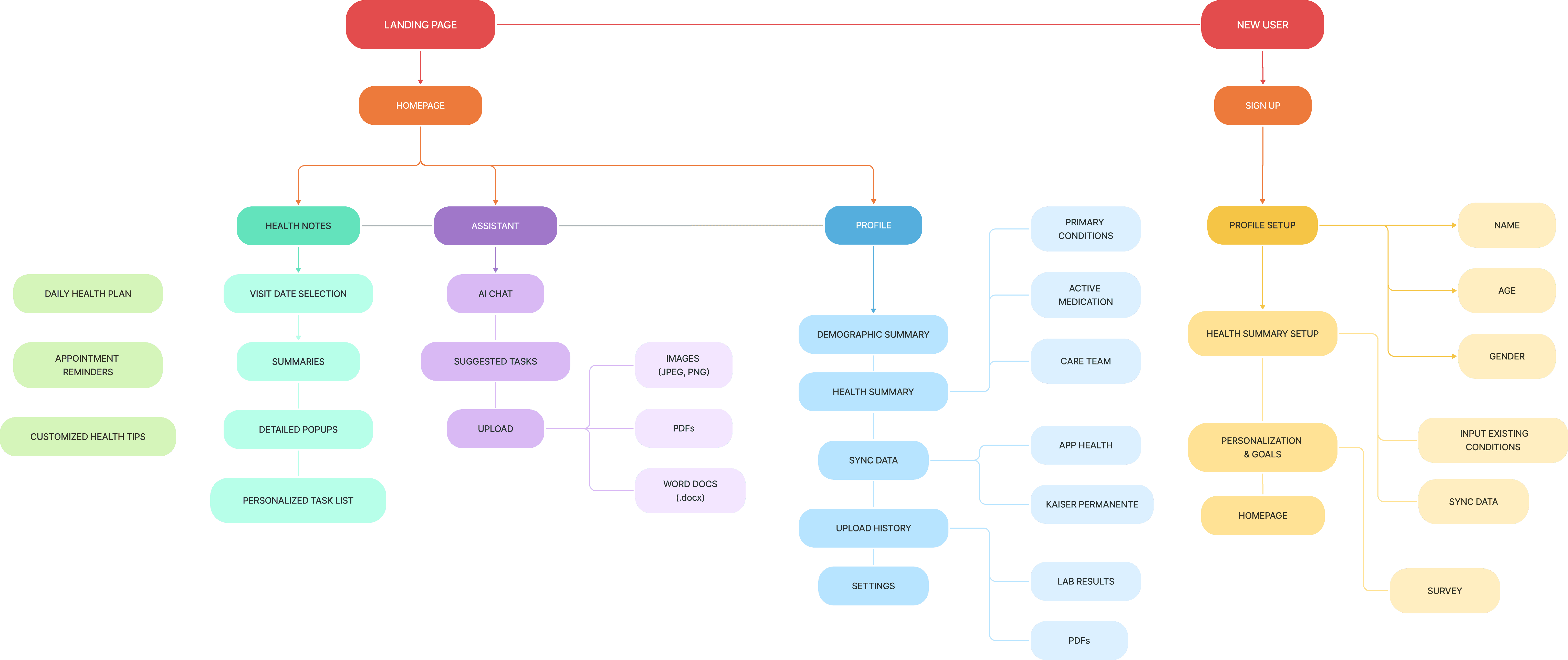
I created a detailed visualization of the user journey, mapping out a comprehensive outline of how users would interact with PulseCheck from onboarding through daily use. A flowchart was designed to capture each step, from reviewing visiting summaries to receiving reminders and connecting with care teams.
This process ensured a logical and intuitive progression, allowing the team to refine the experience and streamline navigation for patients with different needs and conditions.
Information Architecture
I created a detailed visualization of the user journey, mapping out a comprehensive outline of how users would interact with PulseCheck from onboarding through daily use. A flowchart was designed to capture each step, from reviewing visiting summaries to receiving reminders and connecting with care teams.
This process ensured a logical and intuitive progression, allowing the team to refine the experience and streamline navigation for patients with different needs and conditions.
Information Architecture
I created a detailed visualization of the user journey, mapping out a comprehensive outline of how users would interact with PulseCheck from onboarding through daily use. A flowchart was designed to capture each step, from reviewing visiting summaries to receiving reminders and connecting with care teams.
This process ensured a logical and intuitive progression, allowing the team to refine the experience and streamline navigation for patients with different needs and conditions.
Final Design
The final prototype brought together our research, insights, and product strategy into a cohesive experience. PulseCheck was designed to feel simple, supportive, and patient-centered, providing users with the tools they need to stay informed and engaged in their care after every visit.
Final Design
The final prototype brought together our research, insights, and product strategy into a cohesive experience. PulseCheck was designed to feel simple, supportive, and patient-centered, providing users with the tools they need to stay informed and engaged in their care after every visit.
Final Design
The final prototype brought together our research, insights, and product strategy into a cohesive experience. PulseCheck was designed to feel simple, supportive, and patient-centered, providing users with the tools they need to stay informed and engaged in their care after every visit.
Project Takeaways
This was my first experience stepping into the role of Product Manager, and it gave me the chance to practice the fundamentals of guiding a product from ideation to validated concept. Over the course of the competition, I explored the essentials skills of product management — product discovery and product planning — and applied them in a real-world context to shape PulseCheck into an interactive prototype.
I learned how to balance different perspectives: intuition from design, analytics from market sizing, and evidence from research and user interviews. Leading the research and scope definition taught me how to translate raw insights into actionable decisions, while collaborating with designers and strategists showed me the importance of clear communication and shared vision.
This project also allowed me to leverage my previous experience with product research. Overall, this experience helped me build a foundation in product thinking and gave me new skills that I can carry forward.
It also left me with questions I'm eager to keep exploring: How can design and MVP assumptions be validated earlier through testing? What is the right balance between personalization and simplicity in healthcare onboarding? And how might product managers continue to center empathy while navigating the constraints of a regulated industry?
Project Takeaways
This was my first experience stepping into the role of Product Manager, and it gave me the chance to practice the fundamentals of guiding a product from ideation to validated concept. Over the course of the competition, I explored the essentials skills of product management — product discovery and product planning — and applied them in a real-world context to shape PulseCheck into an interactive prototype.
I learned how to balance different perspectives: intuition from design, analytics from market sizing, and evidence from research and user interviews. Leading the research and scope definition taught me how to translate raw insights into actionable decisions, while collaborating with designers and strategists showed me the importance of clear communication and shared vision.
This project also allowed me to leverage my previous experience with product research. Overall, this experience helped me build a foundation in product thinking and gave me new skills that I can carry forward.
It also left me with questions I'm eager to keep exploring: How can design and MVP assumptions be validated earlier through testing? What is the right balance between personalization and simplicity in healthcare onboarding? And how might product managers continue to center empathy while navigating the constraints of a regulated industry?
Project Takeaways
This was my first experience stepping into the role of Product Manager, and it gave me the chance to practice the fundamentals of guiding a product from ideation to validated concept. Over the course of the competition, I explored the essentials skills of product management — product discovery and product planning — and applied them in a real-world context to shape PulseCheck into an interactive prototype.
I learned how to balance different perspectives: intuition from design, analytics from market sizing, and evidence from research and user interviews. Leading the research and scope definition taught me how to translate raw insights into actionable decisions, while collaborating with designers and strategists showed me the importance of clear communication and shared vision.
This project also allowed me to leverage my previous experience with product research. Overall, this experience helped me build a foundation in product thinking and gave me new skills that I can carry forward.
It also left me with questions I'm eager to keep exploring: How can design and MVP assumptions be validated earlier through testing? What is the right balance between personalization and simplicity in healthcare onboarding? And how might product managers continue to center empathy while navigating the constraints of a regulated industry?
Ready to build something amazing?
I'd love to connect with you!
Ready to build something amazing?
I'd love to connect with you!
Ready to build something amazing?
I'd love to connect with you!